The dimensions of tribal behaviour
Gaining access to the deepest and strongest humans motivators
5 min read
Originally posted on Medium · View original →
Gaining access to the deepest and strongest humans motivators
I’ve seen many teams, departments and organisations trying to rediscover themselves, to find a more effective way to function in this new fast-paced economy.
What is interesting is that although every organisation has its different context, they always face similar stories which have a common denominator: the social dynamics.
Have a look at those common anecdotes:
“Each group defended its own turf, setting their own agendas above those of the company.”
“Everyone blames everyone else.”
“We desperately want to build and manage a great place to work, but every day we face a cesspool of dissent, non-cooperation, hidden agendas, power play, concealed realities, backstabbing, and low-level warfare.”
“My colleague was upset about what he considered to be an invasion of his territory.”
“There seems to be an undercurrent of behaviour that I cannot pin down.”
“Everybody focuses on where the next assault is going to come from and how their alliances are holding up, rather than putting effort into making the organisation more effective.”
“We seem to be locked into an ongoing low-intensity war.”
“I feel a deep, hooded distrust behind the friendly faces.”
“There are a different, hidden set of rules dictating behaviour.”
“Everyone has been on the defensive, blaming management for all the problems.”
“Nothing physical preventing our team from delivering more. The tools are first-class, the office is great, the market is asking for more features, and the management team appears to be very capable, but still, they cannot deliver faster and more frequent.”
“In all the previous meetings, they had fought like cat and dog. In this meeting, however, it seemed like they ganged up on management.”
Let’s talk about the human primitive and instinctive behaviour and how we operate as human beings. A model where you can get some insights into the deepest and strongest motivators that humans possess.
Tribes
Tribes seems to be the default natural organisational form. It’s the oldest organisational structure known and they still exist in this modern day and age.
Individuals are socially, emotionally, and psychologically defined by their tribal membership
By being part of a tribe, we seem to gain a sense of identity, a way of defining ourselves through the tribal affiliations we maintain. Throughout our lives, our social identities are made up of all the tribes we associate ourselves with. The more tribes we belong to, the better we are defined as individuals.
Believe it or not, you are dealing with tribes in your company! All micro-narratives above are symptoms of deep-rooted tribal behaviour. Even though we don’t call them tribes any longer, (we might call it departments, silos, groups, clubs) people still behave according to deeply ingrained tribal rules that governs our behaviour and social interaction.
The dimensions of the tribal behaviour.
Individuals act to reinforce their security when under threat
We have the need to belong to groups where we feel safe. It seems that together we are stronger.
In corporate world, usually people experience more trust and emotional refuge in a tribal structure than in an organisational structure.
Think about that: in war times, the iron rule for troops usually is “never leave your buddy behind” no matter how desperate the situation is. That’s the strongest form of trust . Everyone knows that, no matter what happen, someone would take care of you.
Individuals act to reinforce their self-worth when their security is not under threat
When things are going well, the individual’ self-worth becomes the big issue.
When not under threat, people feel confident to chase their dreams and ambitions. Is likely we will arrange ourselves in a way that will increase the likelihood for us to to get that new job or position or simply work in the things that interest us the most.
Tribes act to secure their self-preservation if their security is under threat
Tribes may experience threats just as individuals do. As we said, individuals who find themselves under threat may seek refuge and safety in their tribe.
If everyone experiences the same threat, the tribe will act to secure its survival, and thereby guarantee the survival of all its members.
Tribes act to reinforce their self-worth when their security is not under threat
Again, when things are going well, the tribe self-worth becomes the big issue.
The tribe will work and build alliances to become stronger, so it can achieve its just cause, preserve their culture, society and value system.
We talked about two dimensions: Security and sense of self-worth, for individuals and tribes. Let’s put that in a 4x4 matrix and see what usually happen when we affect those dimensions, both positive and negatively.
Let’s start with the security dimension:
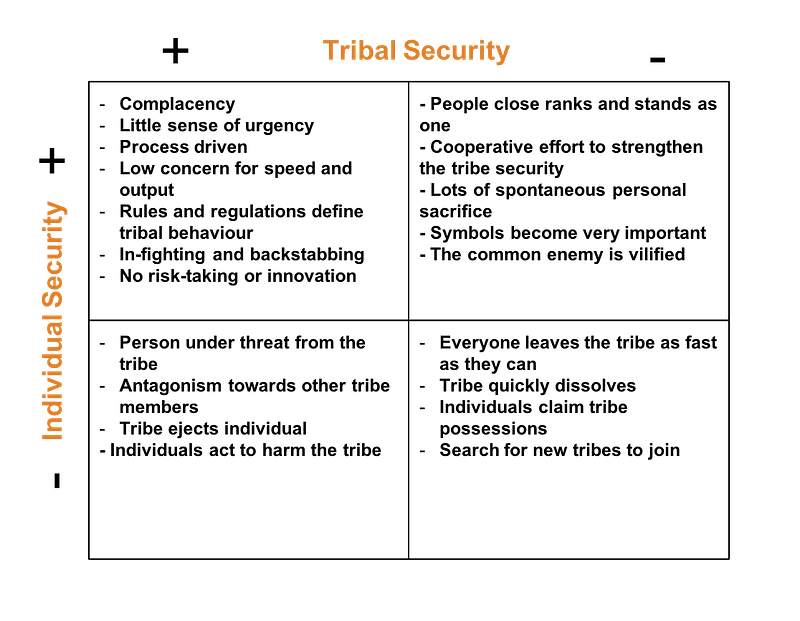
Which of the quadrants above would your team benefit the most?
Probably top right, where individual security is high, but the tribal security is low.
Now, let’s explore the self-worth dimension:
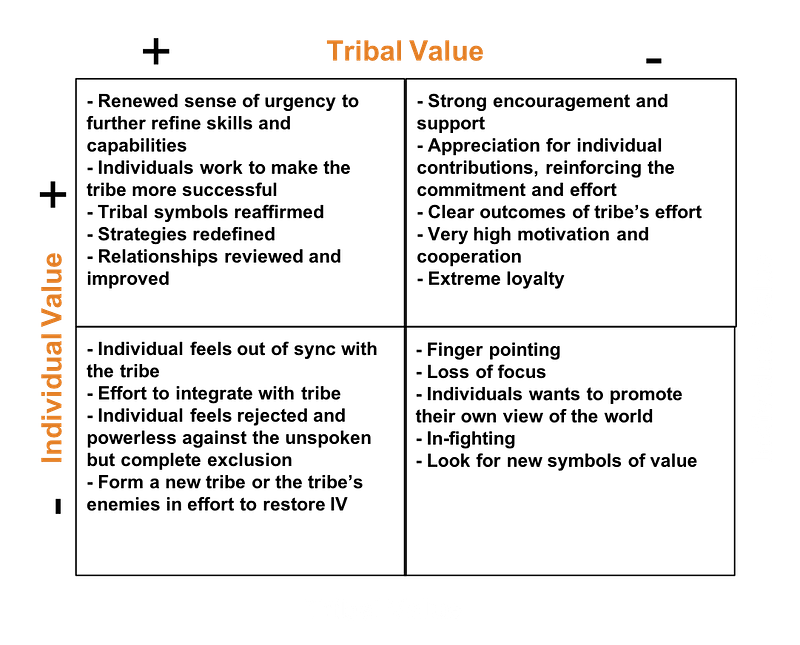
Again, which of the quadrants above would your team benefit the most?
In this case, probably the the top left one, when both individual and tribal value is high and the top right one, when individual value is high, but the tribal value is low.
When talking about sense of self-worth, you’d probably want design to oscillate between the two of them.
In the next post, we’ll discuss organisation and culture design strategies to unleash an incredibly powerful behavioural trait, and gain access to the deepest and strongest motivators that humans possess. If we learn how to do it correctly, we can build organisations that are so motivated, that are virtually unstoppable.
The content of this and few other blogs in the same topic comes from the Great Boss Dead Boos book by Ray Immelman, which I highly recommend. A life changing reading!
Till the next time!
Marcio Sete